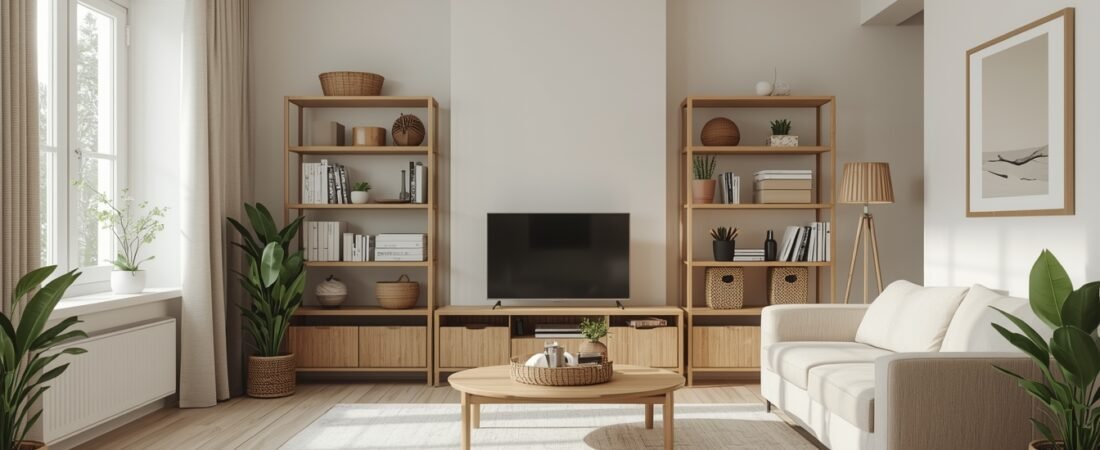
Many homes use both organisation systems and storage solutions, but the two concepts are often treated as if they mean the same thing. Shelves, cabinets, bins, and drawers are frequently added with the expectation that more storage will automatically create a more organised space.
In practice, storage and organisation serve different purposes. Storage provides a place for items to exist within the home, while organisation determines how those items are arranged so they remain accessible and easy to maintain.
Storage provides physical space
Storage refers to the physical locations where belongings are kept. Cabinets, closets, shelving units, and containers are all examples of storage. Their primary purpose is to hold items safely within a home.
Adding storage can be helpful when households simply lack enough physical space for their belongings, but storage alone does not determine how easy a room is to use.
Organisation creates structure
Organisation focuses on how items are grouped, arranged, and accessed within storage areas. It establishes the structure that allows belongings to remain easy to find and simple to return after use.
- Clear categories for different types of items
- Storage locations that match frequency of use
- Boundaries that prevent categories from mixing
This broader relationship is explained further in Home Organisation Basics: How Functional Spaces Stay Usable Over Time.
Adding storage does not always solve the problem
When a home begins to feel cluttered, a common response is to introduce additional storage containers or shelving. While this may temporarily create more space, it does not always resolve the underlying issue.
If items are placed into new storage without clear organisation, the result may simply be larger storage areas that remain difficult to manage.
Storage without organisation can hide clutter
Some homes contain large amounts of storage but still experience persistent clutter. This often occurs when storage areas hide disorganisation rather than resolving it.
- Items are purchased again because they cannot be found.
- Storage spaces become difficult to access.
- Belongings gradually spread into surrounding areas.
Without organisation, storage capacity alone rarely keeps a home functioning smoothly.
Organisation helps homes adapt
Homes naturally change over time. Households acquire new belongings, hobbies evolve, and routines shift. Organisation systems help homes adapt to these changes by providing flexible structures for managing items.
When organisation is clear and intentional, adjusting storage becomes easier. Categories can expand or contract as needed, and items can be relocated without disrupting the entire system.
Balanced systems support functional spaces
The most functional homes tend to balance both storage capacity and organisational structure. Storage provides the physical space required to hold belongings, while organisation ensures those items remain accessible and easy to manage.
When the two work together, rooms are more likely to remain usable over long periods of time. That connection to routine use is also explored in How Organisation Affects Daily Use of Space.