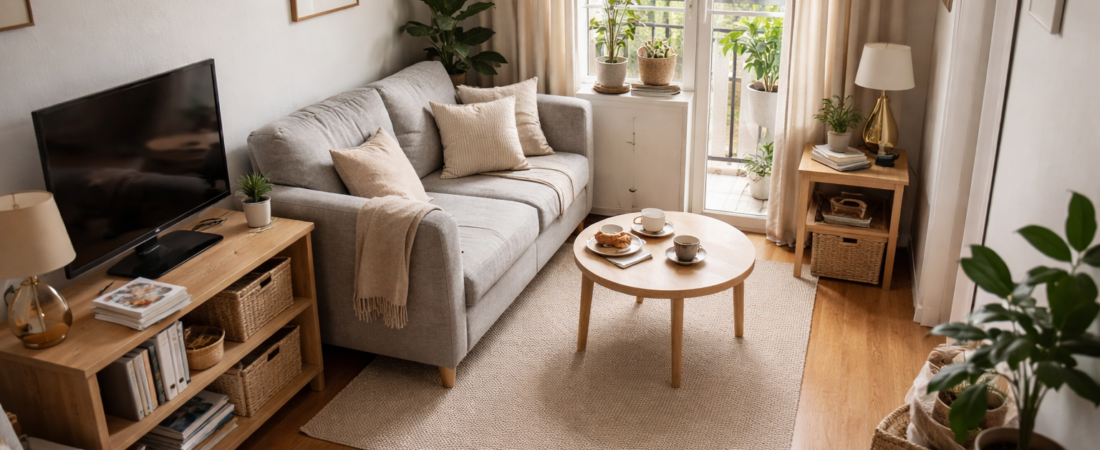
Small spaces often feel more difficult to organise, even when there is less total area to manage. The challenge is not simply size. It is how space functions under constraint.
When room is limited, every object competes for visibility, access, and placement. There is less margin for overflow, and fewer areas where items can be temporarily set aside. Small spaces require more precise decisions.
Understanding why they feel harder to organise helps reduce frustration and leads to more practical solutions.
Limited Surface Area Increases Visual Clutter
Visual clutter is not only about how much you own. It is about how much is visible at one time. Small rooms often have:
-
Fewer closed storage options
-
Shorter bench or counter space
-
Narrow walkways
-
Lower ceilings
Because of this, normal daily items remain in sight. The space feels busy more quickly.
Reducing visibility rather than reducing possessions is often the first practical step.
Fewer “Buffer Zones”
Larger homes usually contain informal storage areas. These might include spare cupboards, wide hallways, garage shelves, or underused rooms.
Small spaces rarely have these buffer zones.
Without overflow areas:
-
Laundry piles up in living spaces
-
Mail lands on dining tables
-
Bags remain near the door
-
Cleaning tools stay visible
The absence of extra space increases the pressure on each area to perform well. When one system fails, the whole room feels disorganised.
Multi-Purpose Rooms Increase Friction
In small homes, one room often serves multiple functions.
A living room may also be:
-
A workspace
-
A dining area
-
A storage zone
-
A guest room
When rooms serve several purposes, items related to different activities overlap. This increases movement of objects and reduces stability in the layout.
Each additional function adds complexity. Organisation becomes harder because systems must support more than one use.
Storage Depth Is Often Shallow
Shallow storage can be helpful for visibility, but it reduces capacity. It also limits how items can be grouped.
For example:
-
Bedding may not fit comfortably into a slim linen cupboard
-
Cleaning tools may not fit upright in a narrow cabinet
-
Kitchen appliances may compete for the same shelf
When storage does not match the size of the items it holds, friction increases.
Less Margin for Mistakes
In larger homes, temporary disorganisation can be absorbed. In small homes, even small disruptions are noticeable.
A chair slightly out of place blocks a walkway.
A box on the floor interrupts movement.
An open drawer changes how the room feels.
Because the space is tight, there is less tolerance for incomplete systems. Small spaces require:
-
Clear pathways
-
Defined zones
-
Appropriate container sizes
-
Regular resets
Without these, disorder becomes visible quickly.
Emotional Pressure Is Often Misplaced
Small spaces are frequently compared to larger homes. This can create unrealistic expectations about what “organised” should look like.
However, small spaces operate under different conditions. They prioritise:
-
Efficiency
-
Access
-
Flow
-
Flexibility
When organisation focuses on supporting movement and daily use rather than visual perfection, small spaces feel more manageable.
A Practical Shift in Perspective
Small spaces feel harder to organise because:
-
Storage options are limited
-
Rooms serve multiple purposes
-
Surfaces fill quickly
-
There is little room for error
The solution is not to force large-home systems into smaller layouts. It is to adjust expectations and build systems that match the physical limits of the space.
For a broader overview of how to approach organising compact or multi-use environments, see Small & Shared Spaces.
Organisation in small homes is less about aesthetics and more about reducing friction. When systems support movement and daily tasks, the space begins to feel usable rather than constrained.
Over time, small, practical adjustments create stability. The goal is not to make the space look larger. It is to make it work reliably within its size.