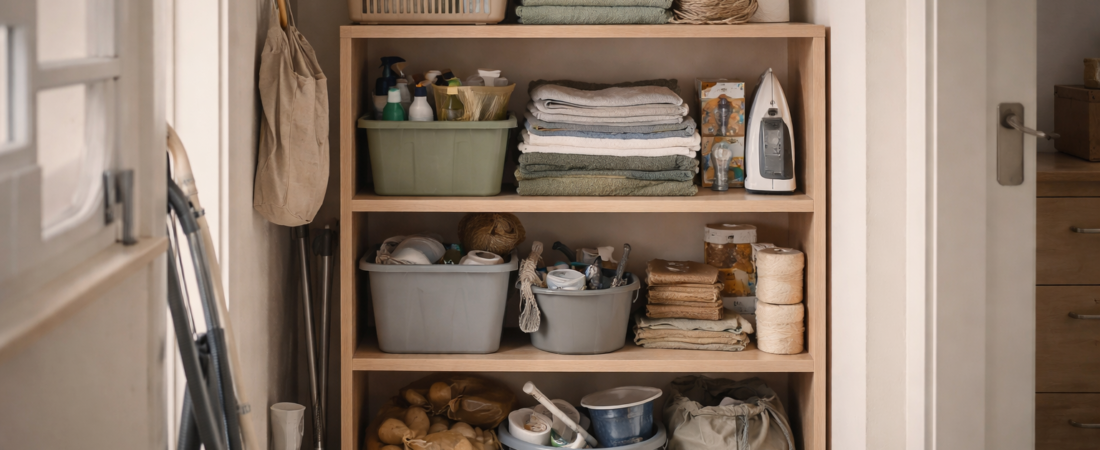
Home organisation is often presented as a visual goal. Clean lines, matching containers, and styled shelves are treated as signs of success. Functional organisation asks a different question: does the space work for everyday use?
This article explains the difference between functional and decorative organisation, why the distinction matters, and how to recognise which approach a space is actually using.
What functional organisation means
Functional organisation is about reducing effort during normal daily use. Items are stored where they are needed, in a way that makes them easy to access, return, and understand.
A functionally organised space prioritises:
-
Short, predictable movement paths
-
Storage that matches how often items are used
-
Visibility or clear labelling where memory load matters
-
Layouts that work even when the space is not perfectly tidy
Function comes first. Appearance is a by-product, not the goal.
What decorative organisation means
Decorative organisation prioritises how a space looks, especially when viewed as a whole. Containers, symmetry, and colour coordination often matter more than ease of use.
Decorative organisation commonly includes:
-
Matching storage regardless of contents
-
Items grouped for visual balance rather than task flow
-
Open shelving styled for appearance
-
Systems that rely on maintaining a specific arrangement
These spaces can look calm and controlled, but often require more effort to keep that way.
Why the difference matters in everyday homes
Most homes are used continuously, not staged occasionally. When organisation systems are decorative rather than functional, friction builds quietly.
Common signs include:
-
Items not being returned to their “proper” place
-
Storage avoided because it is inconvenient
-
One person maintaining the system while others bypass it
-
Clutter reappearing despite regular tidying
Functional organisation reduces the need for correction. Decorative organisation often increases it.
This distinction is part of a broader approach to functional home organisation, which focuses on reducing everyday effort rather than maintaining a particular visual style.
Functional systems tolerate imperfection
A key difference is how each system behaves when things are not ideal.
Functional organisation still works when:
-
One item is out of place
-
A drawer is overfilled temporarily
-
Someone unfamiliar uses the space
Decorative organisation tends to fail under the same conditions. Once the visual order is broken, the system no longer guides behaviour.
Decorative elements are not always a problem
Decorative choices are not inherently wrong. Problems arise when decoration replaces function rather than supporting it.
Decoration can work when:
-
Containers are chosen after storage needs are clear
-
Open shelving holds items used frequently
-
Visual consistency helps quick identification
The issue is not decoration itself, but allowing appearance to dictate structure.
How to tell which approach a space is using
A simple test is to observe behaviour rather than appearance.
Ask:
-
Where do items naturally accumulate?
-
Which storage locations are avoided?
-
What gets moved during normal use?
If people repeatedly work around the system, it is likely decorative. If the system supports habits without effort, it is likely functional.
Choosing function without making the home feel clinical
Functional organisation does not require industrial solutions or bare spaces. It focuses on alignment between use and layout.
Practical steps include:
-
Storing items at the point of use
-
Allowing flexible or forgiving storage
-
Accepting visual variation if it reduces effort
-
Letting daily routines shape the system over time
A home can feel calm without being styled.
Why BetterHomeSpaces prioritises function
This site focuses on long-term usability rather than short-term visual results. Functional organisation reduces decision fatigue, maintenance effort, and frustration.
Decorative organisation may look complete. Functional organisation continues to work.
That difference is the foundation of a calmer, more usable home.