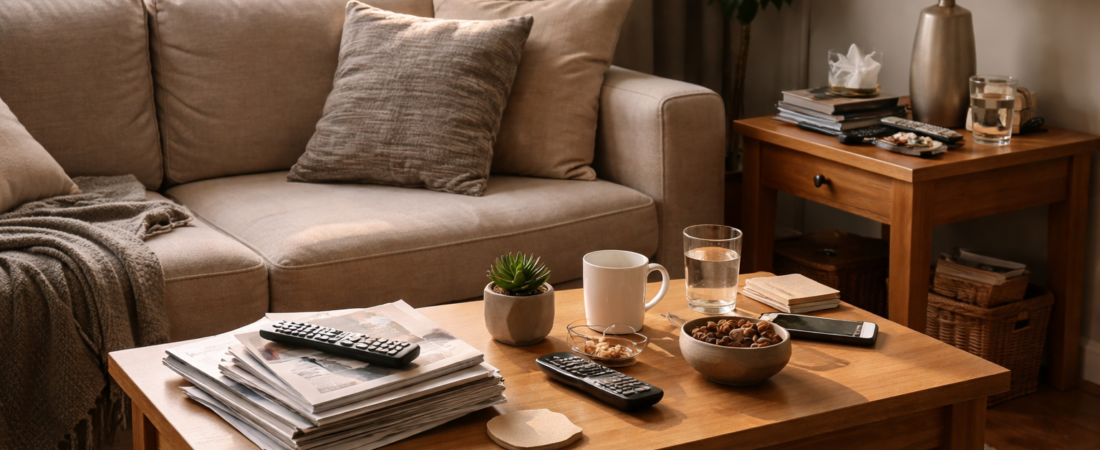
Many people are able to declutter a room once. The challenge usually appears later, when the space gradually fills again. Drawers that were once clear become crowded, surfaces collect items, and storage areas slowly lose the structure that originally made them useful.
This pattern is common in ordinary homes. Decluttering often feels temporary because the conditions that caused the clutter have not changed.
Understanding why clutter returns can make it easier to maintain usable spaces over time.
Decluttering Often Focuses on Removal, Not Systems
Most decluttering efforts focus on removing items. This can create immediate visual improvement, but it does not necessarily change how objects move through the home.
When items do not have stable storage locations, they tend to accumulate in convenient places such as tables, countertops, or chairs. Over time, these temporary locations become permanent storage areas.
Decluttering works best when it is paired with simple systems that determine where everyday items belong.
If a home relies only on occasional clearing rather than consistent placement, clutter gradually rebuilds.
Everyday Life Continues to Add New Items
Homes are constantly receiving new objects. Mail arrives, purchases are brought inside, paperwork accumulates, and household supplies are replaced.
Even small additions can slowly change how a space functions. When these incoming items do not have clear destinations, they often remain in visible areas.
Decluttering once does not stop the steady flow of new items into a home. Without ongoing placement decisions, spaces can return to their previous state.
Storage Areas Fill Gradually
Closets, cabinets, and drawers often start with extra capacity after a decluttering session. Over time, this available space tends to fill.
This process usually happens slowly. A drawer that once held only essential items begins to accept additional objects because space is available.
Eventually, the storage area reaches the same level of crowding that existed before decluttering.
When storage spaces are already near capacity, it becomes difficult to maintain the structure that supports everyday use.
Habits Are Harder to Change Than Spaces
Decluttering can change a space quickly, but habits usually take longer to adjust.
If daily routines continue to place items in temporary locations, those patterns will gradually reshape the room again.
For example, placing mail on the same table each day or leaving frequently used items on a counter can recreate clutter even in an otherwise organised space.
Long-term maintenance usually depends more on consistent placement habits than on occasional large decluttering efforts.
Visual Calm Can Be Misleading
A newly decluttered room often appears calm and spacious. This can create the impression that the problem has been solved permanently.
However, the appearance of order does not always reflect the underlying structure of the space. If storage decisions remain unclear or inconsistent, the room may slowly return to its previous state.
The visible improvement from decluttering can therefore mask the need for simple systems that guide everyday use.
Decluttering Is an Ongoing Process
Maintaining functional spaces rarely depends on a single major decluttering effort. Instead, it usually involves small adjustments over time.
Removing items occasionally can help restore balance when spaces begin to feel crowded. More importantly, clear storage locations and consistent habits make it easier to maintain the original structure of a room.
When homes support everyday activities without requiring frequent large resets, spaces tend to remain usable for longer periods.
Understanding these patterns can make decluttering feel less like a one-time task and more like a gradual process of maintaining functional space.
This broader perspective is explored in Decluttering and Space Management: Keeping Homes Functional Over Time.